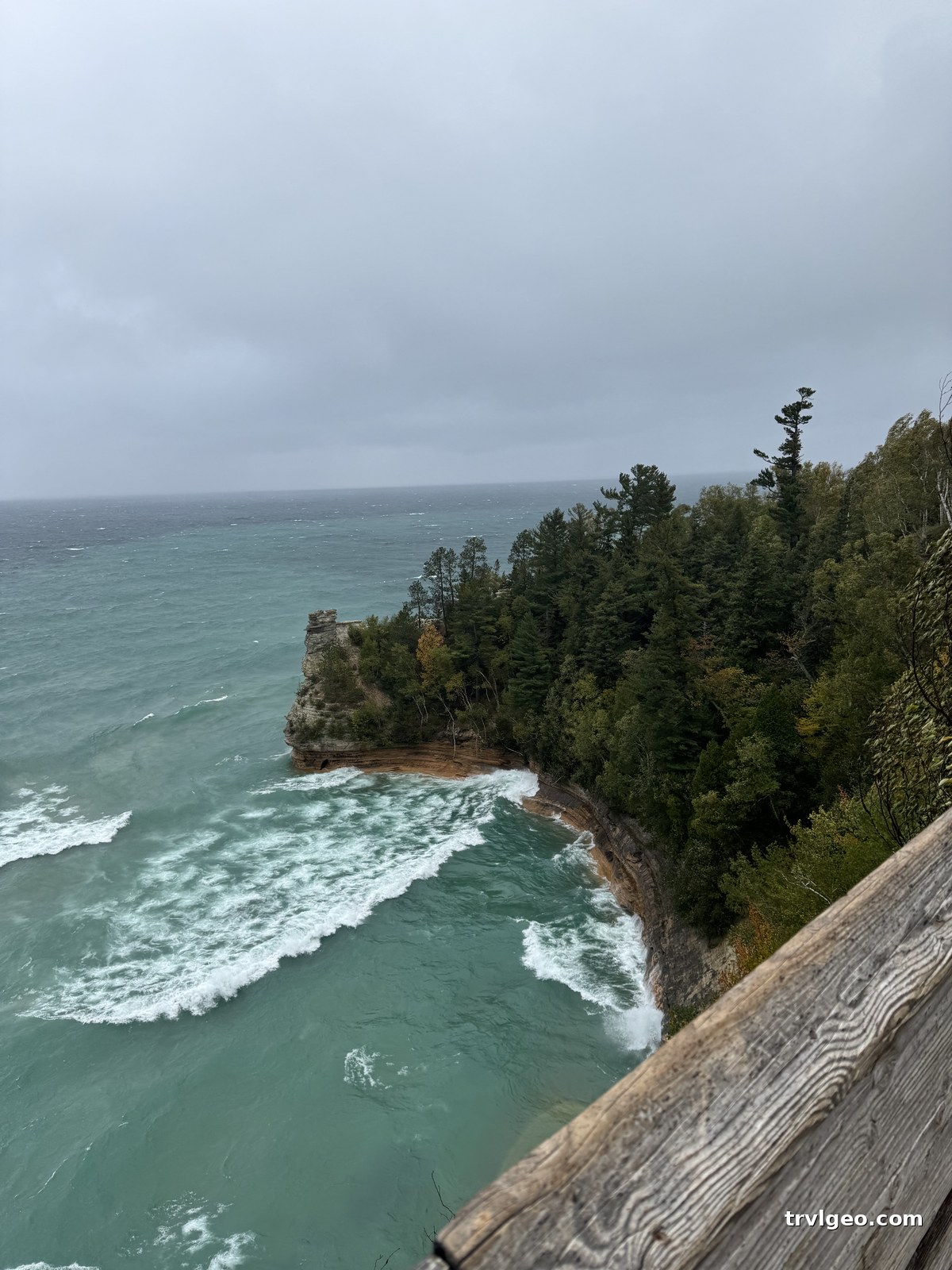
Part 2 of How the Land Got Its Shape.
From the water below Miners Castle, the cliffs look brushworked. Colour runs down the rock in long streaks, red over rust over a green so pale it reads as teal, as if somebody painted the wall and then left it out in the rain. Nobody painted it. The artist is groundwater, seeping out of the cliff one trickle at a time, and it has not finished.

The rock underneath the colour is almost plain: pale sandstone in greys and pinks. The colour sits on the surface, and it arrives in water. Rain and snowmelt sink into the ground above the cliffs and move slowly through soil and rock, dissolving metals on the way. Where a crack crosses the cliff face, the water oozes out and trickles down toward the lake. As it dries, the metals stay behind as stain, laid over stain, in the exact path the water took. Each colour is a different metal, delivered by the same groundwater:
| Colour on the cliff | Left behind by |
|---|---|
| Red and orange | Iron |
| Blue and green | Copper, the rarest colour on these cliffs |
| Brown and black | Manganese |
| White | Limonite |
That is also why the colours run in streaks instead of bands. A streak is a plumbing line, the route one seep takes from its crack to the water below. A steady seep stains dark. A seep that only runs after rain leaves a ghost. The rock layers underneath run level, laid down flat in an ancient sea. The painting ignores them and follows the water downhill.
The wall under the paint
Two very different ages of rock hold the painting up. Down at the waterline sits the Jacobsville Formation, a deep red sandstone laid down by ancient rivers between about 1.1 billion and 980 million years ago, when nothing with a backbone existed anywhere on Earth. Its red runs all the way through the rock, iron oxide mixed into the sand itself. Above it, after a gap of hundreds of millions of years, sits the Munising Formation, sand from a shallow Cambrian sea about 500 million years ago. Miners Castle is carved from the top layer of the Munising, a soft, crumbly sandstone roughly 140 feet thick.
The wall those seas and rivers left behind runs about 15 miles along the shore and stands 50 to 200 feet above the lake. Superior’s waves undercut it, winter ice works in the cracks, and pieces let go without asking. On the morning of 13 April 2006, fishermen out on the water watched the northeast turret of Miners Castle slide into the lake and phoned it in. The castle has worn one turret ever since. The lake doing that slow demolition is the same one from Part 1, and the basin it fills was scoured by the ice sheets in The Ice Age Drew This Map.
So what, if you never visit?
You have met this chemistry at home, at a smaller scale: rust weeping from a bolt on a garden wall, dark runs below a leaking gutter. Pictured Rocks is the same process with 200 feet of canvas and a wall half a billion years old. And the painting is neither finished nor fixed. The stains keep arriving while the cliff keeps retreating, so every photograph of this shore, ours included, is already slightly out of date.
Next week: a white mountain floats in the sky over Seattle, and the danger it poses is not lava. It is mud. The Volcano in Seattle’s Backyard is Part 3.
What natural color stopped you in your tracks?
Keep exploring
Enjoy this? Get 10 maps that will change how you see the world, free.
Quick answers
What paints the colours on the Pictured Rocks cliffs?
Groundwater. Rain and snowmelt sink in above the cliffs, dissolve metals as they move through soil and rock, then ooze out of cracks and trickle down the face. The metals stay behind as stain: iron leaves red and orange, copper leaves blue and green, manganese leaves brown and black, and limonite leaves white.
How old is the sandstone at Pictured Rocks?
The cliff-forming Munising Formation is about 500 million years old, laid down in a shallow Cambrian sea. Below it, at the waterline, the Jacobsville Formation is far older: between about 1.1 billion and 980 million years old.
How big are the Pictured Rocks cliffs?
They run about 15 miles along the Lake Superior shore in Michigan’s Upper Peninsula and stand 50 to 200 feet above the water.
Leave a Reply